AI-Powered Telegram Content Bot: Setup Guide for 2026
AI-Powered Telegram Content Bot: Setup Guide for 2026
TL;DR. A working AI Telegram bot in 2026 needs five decisions made on purpose: which LLM you call, what your prompt template actually looks like, how often it posts, where the images come from, and how you stop it from drifting off-brand or hallucinating numbers. Make those decisions explicitly and you ship a bot that publishes daily without supervision. Skip them and you ship a hallucination machine your subscribers unsubscribe from in week two.
If you want to skip the wiring and use a managed pipeline that already handles every step below, start a free Autogram trial — channel onboarding, prompt presets, scheduling, and cost caps are all configured in the UI.
Prerequisites
Before you write a line of code or fill in a single form, line these up:
- A Telegram bot token from
@BotFatherand bot added as admin to the target channel (not just member — admins can post). - An LLM API key for at least one provider — OpenAI, Anthropic, or an OpenRouter key that fronts both plus open-weight models like Llama 4.
- A content brief for the channel: niche, voice, posting cadence, off-limits topics, and one or two reference posts you consider "ideal." This becomes the prompt skeleton.
- A budget cap in dollars per month. Pick the number now, before you see your first invoice.
- A way to store posts between generation and publish (a database row, a draft queue, anything that lets a human peek before send for week one).
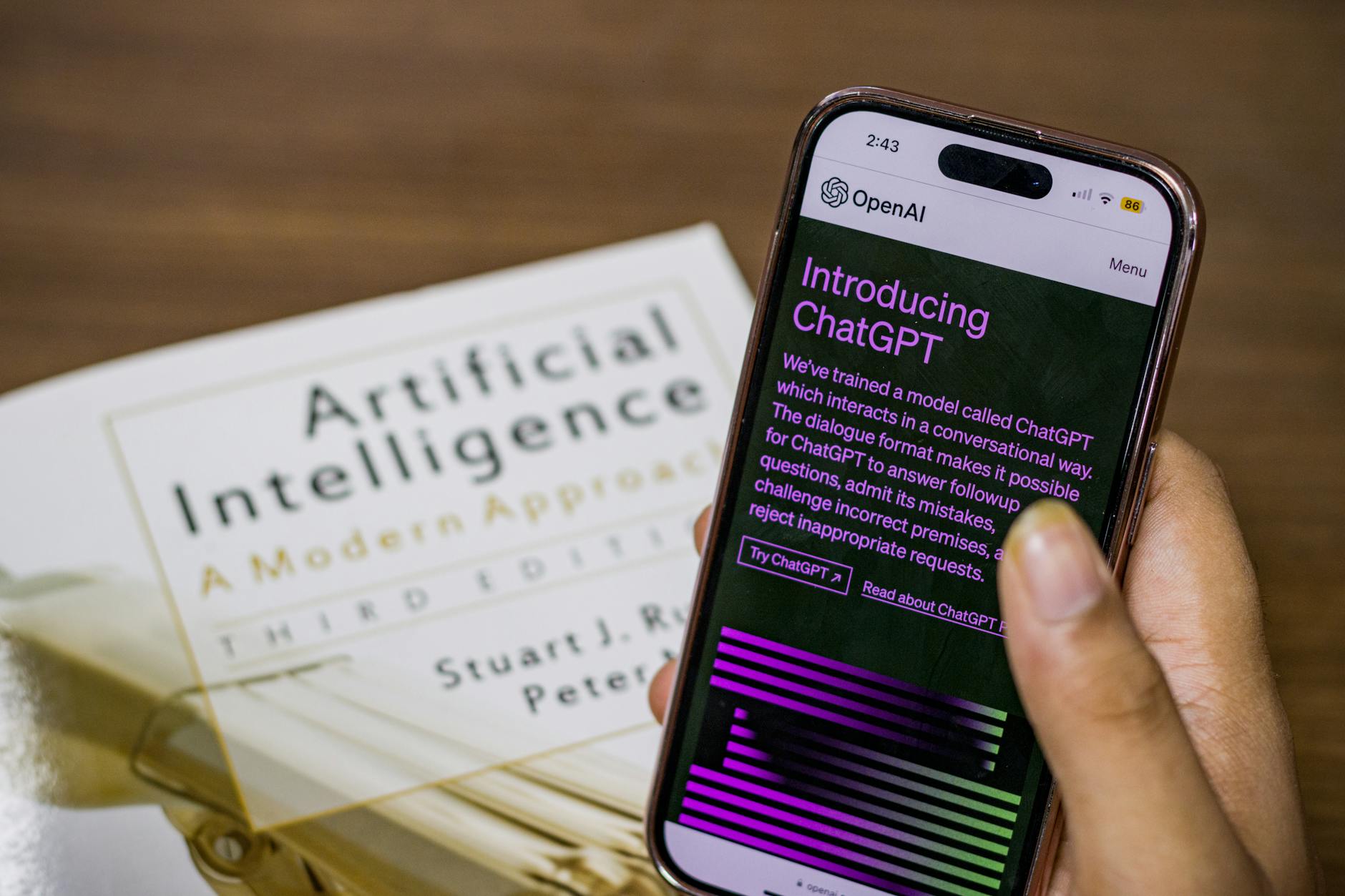
Photo by Sanket Mishra on Pexels
If any of those is unclear, stop and write it down. Every problem we've debugged on a customer's AI bot in the last twelve months traces back to a missing line in one of these five.
Step 1 — Pick the model (and a backup)
In 2026 there is no single "best" model for short-form Telegram posts; the decision depends on three things — cost per million tokens, latency under bursty load, and how well the model holds your brand voice when given a tight prompt.
| Provider | Model class | Strengths | Watch out for |
|---|---|---|---|
| OpenAI | GPT-5.4 / GPT-5.4 mini via the Responses API | Voice consistency, easy structured output, mature SDK | Price ramps fast on long system prompts |
| Anthropic Claude | Claude Sonnet 4.6 / Haiku 4.5 | Strong at long-form summarization and multi-language nuance | Lower throughput than OpenAI on bursty workloads |
| OpenRouter (Llama 4, Mistral, etc.) | Open-weight models behind a unified API | Cheapest for high-volume; one key, many models | Brand voice drifts more across model versions |
The pragmatic answer for most Telegram channels in 2026 is GPT-5.4 mini for the daily volume + GPT-5.4 (or Claude Sonnet 4.6) for the weekly long-form post. Cheap-and-fast for the noise; smart-and-careful for the signal. Wire both providers from day one — the day one of them rate-limits or has an outage, your bot keeps posting.
For Cyrillic locales (Ukrainian, Russian) test your candidate models on five real posts in your tone before you commit. Llama and Mistral are cheap, but their UK/RU prose can read transliterated. GPT-5.4 and Claude both produce idiomatic Cyrillic when prompted in-language.
Step 2 — Design the prompt template
The prompt is where 90% of the quality lives. Treat it like a config file, version it, and never edit it inline in production code. A good Telegram prompt template has five blocks:
- System role — who the bot is for this channel.
- Tone constraints — voice, reading level, emoji policy, profanity rules.
- Format constraints — length, MarkdownV2 escaping, link policy, hashtag rules.
- Topic input — the seed (a news headline, an RSS item, a daily theme, a number from your analytics).
- Anti-hallucination rules — what the model is forbidden to invent.
A working English example, scoped for a SaaS news channel:
You write daily posts for a Telegram channel about no-code SaaS launches.
Audience: small-team founders, technical but not engineers.

Tone: friendly, never breathless. No marketing jargon. No exclamation marks.
At most one emoji per post, at the start, only if it adds meaning.

Format: 280-450 characters total, MarkdownV2-safe, end with a single
hashtag from this allow-list: #SaaS, #NoCode, #LaunchOfTheDay.
Wrap any product name in *bold*. No inline links unless the input includes one.

You will receive a launch summary as input. Write the post in 3 short
paragraphs: hook, what it does, why it matters today.

ABSOLUTELY DO NOT:
- Invent funding numbers, founder names, or launch dates not in the input.
- Compare the product to other companies the input did not mention.
- Add a call to action.
Every variant of this template should live in version control with a date suffix (saas-news-v3-2026-04.txt) so you can roll back when a model upgrade silently changes output style. The day OpenAI or Anthropic ship a new minor version, your prompt may need a tweak — git history is how you isolate the regression.
For non-English channels, translate the prompt itself into the target language. Models follow instructions in the language they were given; an English prompt for a Ukrainian-language post produces noticeably more anglicized prose than a Ukrainian prompt for the same post.
Step 3 — A working Python example
Here is the minimum viable pipeline — generate with the OpenAI Responses API, escape for MarkdownV2, send via the Bot API. About 30 lines, no framework.
Photo by Christina Morillo on Pexels
import os
import re
import httpx
from openai import OpenAI

SYSTEM_PROMPT = open("prompts/saas-news-v3-2026-04.txt").read()
MD2_ESCAPE = re.compile(r"([_*\[\]()~`>#+\-=|{}.!])")


def escape_markdown_v2(text: str) -> str:
    return MD2_ESCAPE.sub(r"\\\1", text)


def generate_post(launch_summary: str) -> str:
    client = OpenAI()  # picks up OPENAI_API_KEY
    resp = client.responses.create(
        model="gpt-5.4-mini",
        input=[
            {"role": "system", "content": SYSTEM_PROMPT},
            {"role": "user", "content": launch_summary},
        ],
        max_output_tokens=300,
    )
    return resp.output_text.strip()


def send_to_channel(text: str, channel: str) -> dict:
    token = os.environ["TELEGRAM_BOT_TOKEN"]
    payload = {
        "chat_id": channel,
        "text": escape_markdown_v2(text),
        "parse_mode": "MarkdownV2",
    }
    r = httpx.post(f"https://api.telegram.org/bot{token}/sendMessage", json=payload, timeout=15)
    r.raise_for_status()
    return r.json()


if __name__ == "__main__":
    summary = "Today: Linear shipped Issue Templates v2 with conditional fields..."
    post = generate_post(summary)
    send_to_channel(post, channel="@your_channel_username")
Two details that will save you debugging time. The escape regex is the official Telegram set from the MarkdownV2 spec — every other "Telegram MD2 escape" snippet on the internet is missing at least one character (! is the usual one). And max_output_tokens=300 is a hard cap so a runaway model doesn't quietly send you a $0.40 generation in place of a $0.004 one.
Step 4 — Decide the posting cadence
The right cadence is the one your subscribers can metabolize and your model can produce without going stale. Three patterns work in practice; pick one and write it down.
- Daily at a fixed hour (the most common). One post per day at the hour your audience opens Telegram. Easy to schedule, easy to A/B against silence.
- Triggered by an external event (RSS, webhook, calendar). The bot wakes up only when there's news worth posting. Best for news channels, worst for habit formation.
- Bursts around a theme (e.g. five posts on Tuesday, three on Friday, none on weekends). Works for educational channels where each week is a topic.
For all three, build in a minimum gap between posts — 6 hours is a sane floor for most channels. The Telegram Bot API allows about 30 messages per second across chats and 1 message per second to the same chat, but that's the technical ceiling. Subscriber fatigue starts well below it.
If you publish to multiple channels with the same theme, do not run the same prompt N times — that produces correlated near-duplicate posts and reads spammy on the Telegram timeline of anyone subscribed to two of your channels. Either parameterize the prompt per channel (different voice constraint per channel) or generate once and rewrite per channel with a second pass. The cost difference is small; the audience-trust difference is large.
Step 5 — Image strategy
You have three options for images, in increasing cost order.
- No images — text-only posts. Plenty of high-engagement Telegram channels are text-only. Don't add images for the sake of it.
- Stock images via Pexels, Unsplash, or your own library. Free at moderate volume; license requires attribution. The lowest-friction option.
- AI-generated images — GPT-Image-2 via the OpenAI Images API or open-weight models like SDXL via Replicate. Costs roughly $0.04–$0.08 per square image in 2026, which compounds.
For most Telegram channels in 2026 the right answer is "stock for daily, AI-generated only for special posts." A stock image library hits the same engagement bar at a fraction of the cost, and it doesn't have the "AI-rendered hands look wrong" problem on the rare image where it matters.
If you do generate images, keep two safeguards in your pipeline. First, never send an unreviewed AI image in week one — text hallucinations damage the brand softly; image hallucinations damage it loudly. Second, watermark or caption every AI image so subscribers know the provenance. The 2026 norm has shifted toward disclosure; channels that hide it lose trust the day a subscriber notices.
Step 6 — Guardrails against hallucination and drift
This is the section every bot-building tutorial leaves out, and it is the one that decides whether your bot is still running in six months.
Photo by Egor Komarov on Pexels
Five guardrails that have saved every AI bot we've operated:
- Never let the model invent numbers. If the post needs a metric, pass the metric in the prompt as a literal. The model paraphrases; it does not compute. Any number in the output that wasn't in the input is, by policy, hallucinated.
- Hard-cap output length. Use the API's
max_output_tokens(or equivalent). A runaway generation costs 100x and reads off-brand. - Auto-flag posts the bot is uncertain about. If you're using the OpenAI Responses API with structured output, add a
confidencefield and route low-confidence drafts to a human review queue instead of straight to the channel. - A/B against silence weekly. Once a week, skip the bot's slot intentionally. Compare the next 48-hour view velocity against bot weeks. If silence outperforms, the bot is hurting more than helping — pause and re-prompt.
- Keep the prompt + model + output for every post for 30 days. When a subscriber complains "this post said X, that's wrong," you need to reproduce the exact generation. Without the trio you cannot.
For week one of a new bot, every post goes through human review before it sends. Set a flag in your pipeline; flip it to "auto-publish" only after seven consecutive days of zero edits at review time. This single rule prevents 80% of "bot says something wrong" disasters.
Step 7 — Cost management
Pick a monthly cap, set up provider-side alerts at 50% and 80%, and instrument a simple per-post cost log.
A daily AI Telegram bot in 2026 with GPT-5.4 mini and a 600-token prompt template costs roughly $0.50 to $2.00 per month per channel for text generation alone. Add stock images: $0. Add GPT-Image-2 images for every post: $1.20 to $2.40 per channel per month at one image per day. Add a weekly long-form post on Claude Sonnet: another $0.50 per month.
Where bills explode is not in steady state — it's in three places:
- Retry storms when the bot loops on a transient API error. Always cap retries at 3 with exponential backoff; never retry indefinitely.
- Long context windows when you accidentally include the channel's last 50 posts as "context" instead of just the last 3. Audit your prompt's input size on every change.
- Vision API calls when you start asking the model to "read" subscriber-posted images. These are 10x the cost of a text-only call and easy to forget you enabled.
Set the cap, log every call's usage.total_tokens, and review the log weekly. The bot should pay for itself in time saved within two weeks; if it isn't, the prompt is asking for too much per post.
How Autogram does this end-to-end
We've shipped this stack as a managed product for the operators who want the result without writing the wiring. Autogram handles the channel verification, OpenAI/Claude/OpenRouter provider routing, prompt presets per channel (with the version-control + rollback you'd otherwise build yourself), Pexels-backed image picking, MarkdownV2 escaping, recurrence and time-zone handling, the human-review-week-one queue, and per-post cost telemetry — all behind a calendar UI.
You bring the prompt and the channel; Autogram brings everything described in Steps 1–7. For most channel owners, the trade-off pencils out: the time to build, monitor, and maintain a custom AI bot pipeline costs more than the subscription within the first two months.
Common mistakes
The five we see most often when reviewing customer setups:
- No version control on prompts. Edits made directly in a config field; no diff history; no rollback when the model changes.
- Sending unedited model output for the first week. Subscribers leave faster than you can fix the prompt.
- One prompt for every channel. A SaaS news channel and a fitness channel cannot share a tone constraint block.
- Ignoring MarkdownV2 escaping. The bot posts fine in tests, then silently fails on a
!or(in production. - No budget cap. Discovered the day the invoice arrives.
Each of these takes ten minutes to fix the day you set the bot up and costs days to fix in the wreckage afterward.
Related reading
- Telegram Channel Bot for Creators: A Five-Hour-a-Week Playbook — the cadence and prompt rituals a solo creator can sustain weekly.
- Multi-Channel Telegram Automation Workflows: 3 Patterns That Scale — chaining RSS, email, or webhook triggers into the bot.
- Telegram RSS Feed Automation Setup: A 2026 How-To — the easiest way to feed your bot real news without hallucination risk.
- Telegram Auto Post Without the Forwarded Tag: A How-To — why your AI-generated posts should be native, not forwarded.
- Telegram MarkdownV2 Escaping: Why Posts Fail Silently (and the Fix) — the escape table every bot needs.
FAQ
Which LLM is best for a Telegram content bot in 2026?
For most channels: GPT-5.4 mini for daily volume, with GPT-5.4 or Claude Sonnet 4.6 for weekly long-form posts. Llama 4 via OpenRouter is the cheapest option but voice consistency varies more across versions. Wire two providers from day one so an outage at one keeps your channel alive.
How much does it cost to run an AI Telegram bot per month?
A daily text-only bot on GPT-5.4 mini runs about $0.50–$2.00 per month per channel. Add GPT-Image-2 image generation for every post and budget another $1–$3 per channel per month. Costs explode on retry storms, accidental long-context calls, and Vision API calls — cap retries at 3 and audit input size on every prompt change.
How do I stop my AI bot from hallucinating facts in posts?
Treat the model as a paraphraser, not a fact source. Pass any numbers, names, and dates as literals in the prompt input. Add explicit "ABSOLUTELY DO NOT INVENT" rules for funding numbers, founder names, dates, and competitor comparisons. For the first week, every post goes through a human review queue before publishing.
Do I need to know Python to set up an AI Telegram bot?
No, if you use a managed tool like Autogram — channel onboarding, OpenAI integration, and scheduling are configured in the UI. Yes, if you want full control over the prompt template, multi-provider routing, and post-generation workflow. The Python example in this article is the minimum viable starting point if you go the build-it-yourself route.
How do I handle MarkdownV2 escaping in AI-generated posts?
Run every model output through a regex that escapes the official MarkdownV2 special character set: _ * [ ] ( ) ~ \ > # + - = | { } . !. Most "Telegram escape" snippets miss !and break silently when the model adds an exclamation mark. Send withparse_mode: "MarkdownV2"` and Telegram returns a clear 400 if anything slipped through.
Should I generate images with AI or use stock photography?
Use stock for daily posts, AI generation only for special pieces. Stock from Pexels or Unsplash is free at moderate volume, doesn't have the "AI-rendered hands" problem, and reads more authentic on the timeline. AI-generated images cost $0.04–$0.08 each in 2026 and require disclosure to retain subscriber trust.
Bottom line
An AI-powered Telegram content bot is a 30-line Python script wrapped in five deliberate decisions: model choice, prompt template, cadence, image strategy, and guardrails. Skip the decisions and the bot ships hallucinations; make them and the bot publishes daily without supervision.
Explore Autogram's AI content tools. Connect your first channel to start 7 days of Solo access, with a $1 AI budget and no card required.
Image credits
- Hero: Photo by Sanket Mishra on Pexels
- Inline 1: Photo by Christina Morillo on Pexels
- Inline 2: Photo by Egor Komarov on Pexels

Subscribe to our newsletter
Get the latest Telegram growth tips, automation strategies, and platform updates delivered to your inbox.
Or follow our Telegram channel